Choosing the right Aluminum Exterior Door manufacturer in China takes more than comparing catalog prices. Frame design, thermal breaks, hardware, and installation details all affect performance. A door may look identical in a showroom yet behave differently after years of rain, sun, and daily use. Small details matter.
UNEP’s 2023 Global Status Report for Buildings and Construction estimates that buildings account for 34% of global energy demand and 37% of energy- and process-related carbon dioxide emissions. These figures describe the building sector, not doors alone, but they show why envelope performance deserves careful attention. For buyers, documented U-factor and solar heat-gain ratings can provide a more useful comparison than broad claims such as “energy-saving.” NFRC labels and applicable performance standards help make those checks concrete.
Building-science expert Joseph Lstiburek expresses a useful principle: “The perfect wall is one that keeps the outside out and the inside in.” That idea applies to an exterior door’s seals, frame connections, and water management—not just its aluminum profile. This guide compares Chinese manufacturers by product range, testing evidence, customization, and export support. It also recognizes a practical limitation: public specifications do not always reveal how consistently a factory controls production. Ask for test reports and project references. Then verify the details.
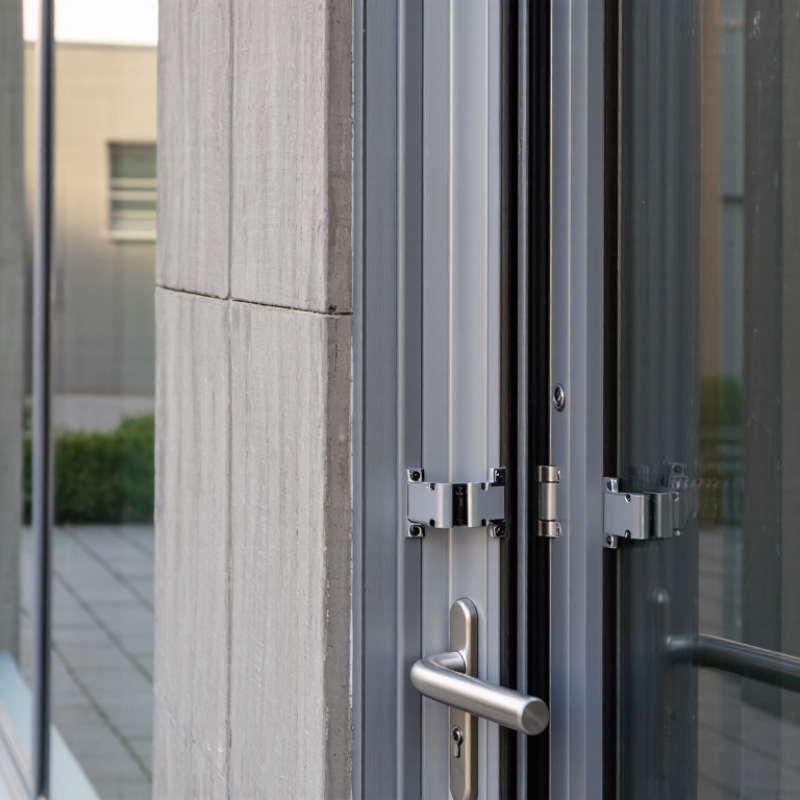
Aluminum exterior doors combine a rigid metal frame with glass, panels, or both. The frame resists warping and supports large openings, while a thermal break helps limit heat transfer between its inner and outer surfaces. Look for continuous weather seals, clear drainage paths, and glazing suited to the local climate. Small details matter.
Hinged doors are common at front and side entrances. They open inward or outward and can provide a solid, familiar seal when properly fitted. Sliding doors move along a track, making them useful where a swinging panel would crowd a patio or hallway. Pivot doors rotate on floor and head hardware, allowing wide, dramatic entrances, but their weight and hardware need careful planning. Folding systems stack panels to create a broad opening. Not every opening needs one.
A wide glass panel looks clean, but it is not automatically the best choice. Consider wind exposure, rain direction, privacy, and how often the entrance will be used. Sill height matters too: a low threshold is convenient, yet it needs effective water management. Ask suppliers about frame sections, glass options, seals, and installation requirements—not just appearance. Even a well-made door can perform poorly if the opening is measured or installed badly. That part is easy to underestimate.
| Door Type | How It Opens | Typical Construction | Key Considerations | Common Applications |
|---|---|---|---|---|
| Hinged (Swing) Door | Swings inward or outward on hinges attached to a side jamb. | Aluminum frame with a glazed or solid panel; commonly supplied as a single or double door. | Provides a familiar, wide-clearance entry when fully open. Requires enough swing space, and weather performance depends on the seals, threshold, installation, and door design. | Main entrances, side entrances, patios, and utility access points. |
| Sliding Door | One or more panels slide horizontally along tracks. | Aluminum-framed glass panels with rollers, tracks, and interlocking meeting rails. | Does not need a swing-clearance area. Track condition, drainage, panel overlap, and the specified locking system affect operation and weather resistance. | Patios, balconies, garden access, and openings with limited interior space. |
| Bi-Fold Door | Multiple hinged panels fold and stack to one or both sides of the opening. | Several aluminum-framed panels connected by hinges and guided by a track system. | Can create a broad opening, but needs space for the stacked panels. Panel alignment, hardware capacity, and correct installation are important for smooth operation. | Wide connections between indoor areas, patios, and outdoor entertaining spaces. |
| Pivot Door | Rotates on pivot hardware positioned at the top and bottom of the panel, often offset from the edge. | A large aluminum-framed door panel with purpose-designed pivot hardware and a compatible frame. | Allows a distinctive, oversized entry design. The opening, panel weight, pivot capacity, clearances, and weather sealing must be planned as a system. | Contemporary main entrances and architectural feature openings. |
| Thermally Broken Aluminum Door | Available in hinged, sliding, and other operating styles; “thermally broken” describes the frame construction rather than the opening method. | Aluminum frame sections separated by a low-conductivity insulating barrier to reduce heat transfer through the frame. | Can improve frame thermal performance compared with a similar non-thermally broken design. Overall results also depend on glazing, seals, thresholds, fabrication, and installation. | Exterior openings where improved thermal performance is a design priority. |
| Non-Thermally Broken Aluminum Door | May be configured as a hinged or sliding door, depending on the system. | Aluminum frame sections without an insulating barrier between the interior and exterior frame surfaces. | Aluminum conducts heat readily, so the frame may transfer more heat than a comparable thermally broken frame. Suitability depends on climate, building requirements, and intended use. | Projects where the applicable performance requirements and local climate make this frame type suitable. |
Selection note: Door performance varies by complete system, glazing, hardware, fabrication, installation, and maintenance. Confirm applicable local building, energy, safety, and weather-resistance requirements for the project.
They use rigid metal frames with glass, panels, or both. Thermal breaks help limit heat transfer. Small details matter.
Sliding doors move along a track, so they do not need a wide swing area. Keep the track clear of grit and water.
Hinged doors suit front or side entrances and can seal well when properly fitted. Pivot doors create wide openings, but their weight needs careful hardware planning. Not every entrance needs drama.
Consider wind exposure, rain direction, privacy, and daily use. A low sill is convenient, but drainage must keep water outside. Glass size alone tells little.
Profiles are cut, machined, and assembled into frames and door leaves. Glass is fitted with setting blocks and seals, then the hardware is adjusted. Alignment matters.
Request whole-door U-values and air-leakage, water-penetration, and wind-load results. Confirm the tested sample matches the proposed size and glass. Ask about batch records, too.
No. It reduces heat transfer through the frame, but glass, seals, and installation also affect performance. A slim frame is not automatically efficient.
Incorrect site measurements or installation can cause drafts, sticking, or water entry. Check corner joints, drainage paths, hardware fixings, and coating on production samples. I would check twice.
Aluminum Exterior Door systems are valued for their strength, light weight, weather resistance, and design flexibility. Common options include hinged, sliding, folding, and multi-panel doors, each suited to different layouts and levels of access. Their performance depends on more than the frame: glazing, thermal breaks, seals, hardware, and surface finishes all contribute to comfort, security, and durability.
In China, manufacturers typically combine profile processing, precision cutting, assembly, glazing, and quality checks to meet varied project requirements. Buyers can assess suppliers by reviewing material specifications, production capacity, customization options, testing procedures, communication, lead times, and after-sales support. Comparing these factors helps identify a suitable partner for residential, commercial, or large-scale projects, while matching the door’s design and performance to the building’s climate, budget, and intended use.

 Fortisdor