Choosing the best Aluminum Entry Door involves more than comparing finishes and showroom prices. A door may look impressive under bright lights, yet perform poorly in wind, rain, or daily family traffic. This guide examines the details that affect comfort, security, durability, and long-term value. It draws on practical installation experience, manufacturer specifications, and advice from qualified door professionals.
Start with your opening, not the catalog image. Measure the frame carefully, including wall depth, threshold height, and swing clearance. A small measurement error can create drafts, binding, or expensive alterations. Look for thermally broken aluminum frames, multi-point locks, adjustable hinges, and continuous weatherstripping. These features help reduce heat transfer and improve everyday operation. Check the door’s water, air, and structural performance ratings when available. Independent test results are more useful than vague marketing claims.
Think about your climate, too. Coastal air can challenge some finishes. Strong afternoon sunlight may fade a low-quality coating. Ask about powder-coat warranties, replacement hardware, glass performance, and maintenance requirements. A certified installer should explain drainage paths and sealant placement before work begins. Do not accept “standard” as a complete answer.
The cheapest option can become costly.
Appearance still matters. Choose a finish that suits your exterior, but test a physical sample outdoors. Colors often change between a screen and real daylight. Even experienced buyers miss this. Review the warranty, installation scope, and after-sales support in writing. A dependable Aluminum Entry Door should combine precise construction with honest documentation, not attractive promises alone.
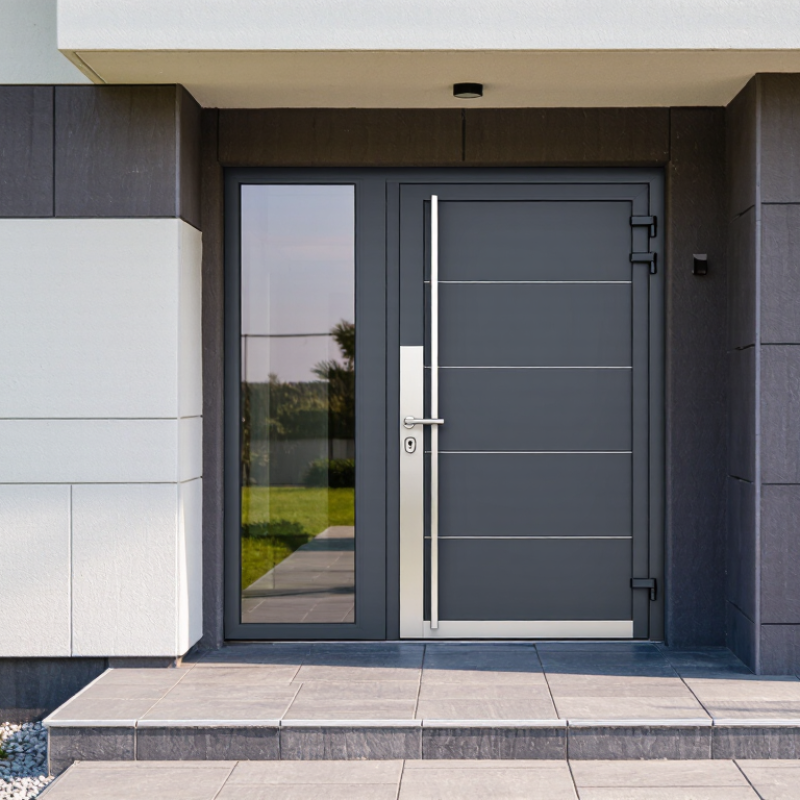
Before comparing finishes, define the doorway itself. Measure the rough opening, wall thickness, threshold height, swing direction, and available landing space. A beautiful door can still fail when the frame is forced into an uneven opening. Record morning and afternoon sun exposure, wind direction, driving rain, and nearby sprinklers. These details affect glass selection, drainage, and corrosion resistance.
Energy performance deserves careful attention. The International Energy Agency reports that buildings consume about 30% of global final energy, so a poorly sealed entrance should not be treated as a minor defect. Check the NFRC label for U-factor, solar heat gain coefficient, and air leakage ratings. Lower U-factor generally means better insulation. For aluminum, specify a thermally broken frame and insulated core. The U.S. Department of Energy notes that air leakage can represent 25% to 40% of heating and cooling energy use in buildings. That figure is not a door-only calculation, but it shows why perimeter seals matter.
Installation conditions can change the result. Confirm the sill pan, flashing sequence, fastener locations, and compatibility with masonry, stucco, or siding. Ask for tested performance under AAMA/WDMA/CSA 101 standards when available. I would not choose by U-factor alone. A low rating cannot repair poor shimming or a twisted frame. That shortcut fails. Leave room for careful adjustment, and inspect the latch, gasket compression, and threshold seal after installation. Some projects still require a second measurement; that is inconvenient, but cheaper than correcting a leaking entrance later.
Choosing the best aluminum entry door starts with comparing its material, profile, and construction quality. Aluminum alloys differ in strength, corrosion resistance, and weight. Ask for the alloy grade and coating specification. A durable finish should resist fading, peeling, and moisture damage.
Feel the sample.
Profile depth matters. Deeper frames usually provide better stiffness and support for heavy glass. Look for a thermal break between the interior and exterior aluminum sections. This reduces heat transfer and helps limit interior condensation. The glass package also deserves attention. Double glazing may improve comfort, while low-emissivity glass can reduce unwanted solar heat.
Construction details reveal more than appearance. Inspect welded or mechanically joined corners for clean alignment and solid contact. Check the weather seals around the entire frame. They should compress evenly without gaps. Hinges must support the door’s weight without sagging. A multi-point lock can improve security and reduce air leakage when correctly adjusted.
I once focused too much on a smooth powder-coated surface. The frame looked excellent, but the weak seal design caused drafts. That mistake changed my inspection routine. Request air, water, and wind performance data when available. Confirm the installation method, because even a well-built door can perform poorly in an uneven opening. Specifications can also mislead when testing conditions differ from real use. Ask practical questions, and compare physical samples before deciding.
How to Choose the Best Aluminum Entry Door?
Thermal performance begins with the frame, not the finish. Choose an aluminum door with a continuous thermal break. This reduces heat transfer through the metal frame. Check the NFRC label for U-factor and air-leakage results. Lower U-factor values generally indicate better insulation. The U.S. Department of Energy estimates that air leakage can represent 25% to 40% of heating and cooling energy use in buildings. A door may look efficient, yet poor installation can undermine its rating. That detail is easy to miss.
Security requires more than a heavy panel. Look for a tested multi-point lock, reinforced strike area, protected cylinders, and strong hinge fasteners. Laminated glass can slow forced entry when glazing is included. Ask for documented test results, not vague claims. Standards from the Fenestration and Glazing Industry Alliance evaluate structural performance, air infiltration, and water penetration. However, test ratings do not replace careful site assessment. The wall, threshold, and surrounding drainage matter too.
Tips: Compare NFRC data before comparing colors. Inspect the sill for drainage paths. Press the weather seal gently; it should rebound without gaps. Request the door’s performance grade and installation instructions. I would also check the threshold after heavy rain, because small leaks often reveal themselves late. A perfect specification cannot correct a twisted frame or rushed installation.
Choosing an aluminum entry door starts with the doorway itself, not a showroom photograph. Measure the opening at the top, middle, and bottom. Older walls often shift slightly. A modern pivot door may look impressive, but a hinged door usually suits narrow entrances better. Consider swing direction, hallway space, and daily traffic before choosing a style.
Size affects comfort, security, and performance. Leave room for accurate fitting and weather seals. A professional installer can check the threshold, frame, and surrounding masonry. Do not assume a larger door always creates a better entrance. I once preferred a wide design, but it made a compact hallway feel crowded. The practical choice was less dramatic.
Finish should match the building’s exposure. Powder-coated surfaces can resist fading, yet darker colors may become hot in strong sunlight. Ask for documented coating performance and maintenance instructions. Glass also needs careful selection. Clear glass brings daylight, while frosted or textured glass protects privacy. Low-emissivity glazing can improve indoor comfort. Laminated or tempered safety glass is worth considering near busy entrances. Check the glass specification, not only the sample.
Inspect hinges, locks, drainage paths, and seal compression before final approval. A reliable supplier should provide measurable specifications, warranty terms, and installation guidance. Small details matter. Even a well-designed door can perform poorly when the frame is uneven or the seal is compressed incorrectly.
| Selection Dimension | Option | Typical Specification | Best For | Key Benefits | Important Considerations |
|---|---|---|---|---|---|
| Door Style | Single Hinged Door | One operating leaf; common nominal widths of 30–42 in (762–1,067 mm) | Most residential front entrances and smaller porches | Simple operation, efficient use of wall space, and broad hardware compatibility | Confirm the required rough opening and whether the door swings inward or outward. |
| Door Style | Double Hinged Door | Two leaves; common total nominal widths of 60–72 in (1,524–1,829 mm) | Wide entrances, formal foyers, and moving large furniture | Creates a larger opening and a balanced architectural appearance | Requires more wall clearance, stronger hinges, and careful alignment of the meeting stile. |
| Door Style | Hinged Door with Sidelites | One door leaf with fixed or operable glazed panels on one or both sides | Entryways that need more daylight without replacing the main door with a wider leaf | Improves natural light and perceived entrance width | Use laminated or tempered safety glass where glazing is near the floor or within a door system. |
| Door Style | Pivot Door | Door rotates on pivot hardware rather than conventional side hinges | Contemporary homes and oversized architectural entrances | Supports large door panels and offers a distinctive modern appearance | Needs precise structural support, adequate swing clearance, and compatible weather seals. |
| Door Style | Flush Panel Door | Flat aluminum face with minimal or no decorative detailing | Minimalist, industrial, and modern façades | Clean appearance, easy visual coordination, and simple maintenance | Surface texture and color are especially important because the broad face is highly visible. |
| Door Style | Panel or Slatted Door | Decorative raised, recessed, or horizontal linear detailing | Homes requiring added visual depth or a warmer design character | Provides architectural interest while retaining aluminum’s corrosion resistance | Check how grooves or slats affect cleaning, drainage, and the overall visual scale of the entrance. |
| Door Size | Standard Single Size | Common nominal door leaf sizes include 36 × 80 in (914 × 2,032 mm) | New construction and standard replacement projects | Usually offers the widest selection of frames, locks, and replacement hardware | Nominal size is not the same as the actual slab or rough-opening size; measure the complete opening. |
| Door Size | Accessible Single Size | A 36 in (914 mm) nominal leaf is commonly selected to help provide a wider clear passage | Accessible homes, aging-in-place projects, and entrances carrying bulky items | Improves maneuverability for wheelchairs, walkers, and strollers | Verify the actual clear opening after accounting for the frame, hinges, stops, and door hardware. |
| Door Size | Custom Height or Width | Made to suit project-specific openings; dimensions vary by structural and system limits | Renovations, tall ceilings, and nonstandard architectural openings | Allows better alignment with the existing façade and interior proportions | Oversized panels may require specialized hardware, additional framing, and engineering review. |
| Frame Type | Thermally Broken Aluminum Frame | Interior and exterior aluminum sections separated by a low-conductivity polyamide barrier | Cold, mixed, or hot climates where indoor comfort matters | Reduces heat transfer and the likelihood of interior condensation compared with an unbroken frame | Thermal performance depends on the complete door assembly, including glass, seals, threshold, and installation. |
| Frame Type | Non-Thermally Broken Frame | Continuous aluminum frame without a thermal separator | Warm climates, detached utility areas, or projects with lower thermal requirements | Generally lighter and often more economical | May conduct more heat and can be more susceptible to condensation in cold or humid conditions. |
| Finish | Powder-Coated Finish | Dry powder cured onto the aluminum surface; available in many solid colors | Most exterior residential and commercial entry applications | Consistent color, good weather resistance, and no liquid-solvent application during curing | Choose an exterior-grade coating and follow the manufacturer’s cleaning instructions to protect the surface. |
| Finish | Anodized Finish | Electrochemically formed oxide layer integrated with the aluminum surface | Modern façades and projects seeking a metallic aluminum appearance | Hard surface with good resistance to flaking and a durable metallic look | Color matching can vary between production batches, so approve physical samples when appearance is critical. |
| Finish | Wood-Look Finish | Decorative coating designed to reproduce the appearance of wood grain | Traditional, transitional, and biophilic exterior designs | Combines a wood-inspired appearance with aluminum’s dimensional stability and low maintenance | Review the grain direction, gloss level, and color sample in outdoor lighting before ordering. |
| Finish | Dark or High-Absorption Color | Deep gray, black, or other dark exterior coating | Contemporary designs and high-contrast façades | Creates a strong visual statement and coordinates well with dark hardware | Dark surfaces can reach higher temperatures in direct sun; verify the system’s color and exposure limitations. |
| Glass Option | Clear Insulating Glass | Two panes separated by a sealed air or gas-filled space | Entrances needing daylight and visibility with improved insulation | Better thermal performance than single glazing while preserving a clear view | Specify safety glazing where required by local building regulations and the door location. |
| Glass Option | Low-E Insulating Glass | Insulating glass with a low-emissivity coating that limits radiant heat transfer | Energy-conscious homes and façades with significant solar exposure | Helps reduce heat loss in heating seasons and solar heat gain in cooling seasons | Select the coating orientation and solar-control level according to the climate and façade direction. |
| Glass Option | Frosted or Acid-Etched Glass | Translucent surface that diffuses light and obscures clear views | Bathrooms near entrances, urban homes, and privacy-focused applications | Provides daylight while increasing visual privacy | Privacy levels vary by pattern and lighting conditions; inspect a sample from both sides. |
| Glass Option | Obscure Patterned Glass | Textured or patterned glass that distorts direct views | Decorative entrances requiring privacy and character | Adds texture and can reduce visibility into the home | Some patterns are directional and may affect how clearly daylight enters the space. |
| Glass Option | Laminated Safety Glass | Two glass layers bonded to an interlayer that remains attached after breakage | Security-conscious entrances, sidelites, and locations exposed to impact or noise | Helps retain broken fragments and can improve acoustic performance | Confirm thickness, interlayer type, and local safety requirements for the complete glazed assembly. |
| Glass Option | Tempered Safety Glass | Heat-treated glass designed to break into relatively small granular fragments | Door glazing and sidelites where safety glazing is required | Stronger than ordinary annealed glass and safer when broken | Tempered glass cannot be cut or modified after heat treatment, so dimensions must be finalized before production. |
| Security | Multipoint Locking System | Locking points engage at multiple locations along the door edge | Large, tall, or security-focused entry doors | Can improve compression of weather seals and distribute locking force | Confirm compatibility with the cylinder, handles, emergency egress needs, and local code. |
| Weather Performance | Adjustable Threshold with Continuous Seals | Threshold and perimeter gaskets designed to limit air and water infiltration | Exposed entrances, windy locations, and energy-efficient homes | Supports more reliable sealing and helps protect interior finishes | Performance depends heavily on a level sill, correct shimming, drainage, and professional installation. |
| Maintenance | Low-Maintenance Exterior | Coated or anodized aluminum cleaned with mild soap, water, and a soft cloth | Homeowners seeking reduced repainting and upkeep | Resists rot and does not require the routine repainting associated with many wood surfaces | Avoid abrasive cleaners, strong solvents, and metal scrapers that can damage the finish. |
| Final Check | Verify the Complete Door Assembly | Review slab, frame, threshold, glass, hardware, seals, and installation details together | Every replacement or new-build project | Prevents mismatched components and improves the chance of achieving the intended performance | Recommended: confirm local code, rough-opening measurements, wind exposure, climate, drainage, and warranty requirements before purchase. |
Choosing an aluminum entry door starts with installation, not color. A replacement in an existing opening usually costs less than a new-frame installation. New construction allows cleaner flashing and insulation access. Remodeling is less predictable.
Before fitting the frame, measure the opening at three heights and widths. Check the sill for rot, then install a sloped sill pan, shims, and low-expansion foam. The U.S. Department of Energy’s building-envelope guidance emphasizes continuous air sealing and water management around exterior openings. Small gaps can become cold drafts or stained interior trim. Experienced installers also test the latch after the frame is screwed tight. Measure twice. Perfect alignment is not guaranteed.
Maintenance is modest, but coastal air changes the routine. Rinse salt and dirt from aluminum surfaces with mild soap every few months. Inspect weatherstripping, drain holes, screws, and the threshold each season. Lubricate hinges lightly, while avoiding oil on dusty tracks. A 2024 national Cost vs. Value remodeling report recorded a 188.1% resale-cost recoupment for steel entry-door replacement, but it did not separate aluminum doors. That limitation matters. Aluminum pricing varies with frame depth, thermal breaks, glass, finish, and hardware. A realistic total-cost worksheet should include the door, frame, delivery, labor, disposal, trim repair, permits, and future maintenance. The lowest quotation may exclude masonry repair. Look carefully.
Measure the width and height at the top, middle, and bottom. Older walls may shift slightly. Use the smallest measurements for planning.
Not always. A hinged door often suits narrow entrances better. Check swing direction, hallway space, and daily foot traffic.
No. A wide door can crowd a compact hallway. I once preferred a dramatic design, but the practical choice worked better.
Powder-coated surfaces can resist fading. Dark colors may become hot in direct sunlight. Coastal air requires regular rinsing with mild soap.
Clear glass adds daylight. Frosted or textured glass improves privacy. Low-emissivity glazing may improve comfort. Safety glass deserves attention near busy entrances.
Check the threshold, surrounding masonry, frame alignment, hinges, locks, drainage paths, and seal compression. Small gaps can create drafts.
Use a sloped sill pan, shims, and low-expansion foam. Maintain continuous air sealing and water management. Measure twice.
Inspect weatherstripping, drain holes, screws, and the threshold each season. Lubricate hinges lightly. Avoid oil on dusty tracks.
Include the door, frame, delivery, labor, disposal, trim repairs, permits, and future maintenance. The lowest quote may omit masonry repairs.
Not reliably. Some reports combine different door materials. Aluminum costs vary with frame depth, thermal breaks, glass, finish, and hardware. That limitation matters.
Choosing the best Aluminum Entry Door begins with understanding your home’s entryway, including its dimensions, wall structure, climate, exposure, and installation requirements. Compare the quality of aluminum alloys, frame profiles, joints, hardware, and overall construction to ensure the door offers strength and long-term stability. Pay close attention to thermal performance, insulation, weather sealing, drainage, locking systems, and impact resistance, as these features affect comfort, energy efficiency, security, and durability.
You should also select a style, size, finish, and glass configuration that match your home’s design and lighting needs. Consider whether the door should open inward or outward, and confirm that the selected glass provides suitable privacy, safety, and insulation. Before making a final decision, review professional installation methods, cleaning and maintenance requirements, warranty coverage, expected service life, and the complete cost of the door, accessories, delivery, and installation. A balanced evaluation will help you choose a practical, attractive, and dependable entrance.

Fortisdor